Wednesday, July 2, 2014

Sunday May 18, 2014 - Diving Into Celtic History - Trinity College, The Book of Kells and the National Museum of Archeology

Why Hibernia?   Where does that name come from?   The Romans, who settled and conquered the British Isles during their spreading empire across Europe and Africa, were never really interested in the more remote island that is now Ireland.  It was too isolated and exposed to the sea.  To them it seemed the perpetual "land of winter."  Hibernus is the Latin word for wintery, thus the name.   According to Neil Hegarty in The Story of Ireland: A History of the Irish People,  they were content to visit the islands off the coast in order to trade with the Celts and Vikings who gave them their good butter and sheep's wool.   I can attest personally to this being a very good reason for travel to Ireland - among many others.   On my third day in the land of my Celtic ancestry, I'm beginning to own my inner Celt, or perhaps Viking, as I read and dive more deeply into the rich lore which comprises this culture.   Janet has been an excellent tour guide and organized my days well.   Today's agenda was Trinity College.

Trinity College, Dublin


Edmund Burke - Irish Republican hero

Touring the campus at Trinity 


Then I visited their library which is home to the Book of Kells probably the most famous and beautiful illuminated manuscript in existence.  Written in 800 AD on the Isle of Iona off the coast of Scotland by Celtic monks, they were threatened constantly by raids of Norse Vikings who sought the gold and jeweled treasures and works of art housed in the monasteries.  With the fall of Rome and the rest of Europe falling into the darkness of the Middle Ages, Irish monasteries remained a stronghold of intellectual life.  There the study of Greek and Latin and the illumination of the gospels and other classic stories of Celtic culture continued for several centuries more.


Eventually the monastery on Iona was over run and burnt to the ground and hundreds of monks were killed.   St. Columba, who is credited with founding this vast network of religious scholarship, had the great foresight to send their greatest treasure inland before the end.  The Book of Kells as it became known was sent to the monastery at Kells for safe keeping and to be completed there.   It illuminates the first four books of the bible: the gospels of Matthew, Mark, Luke and John.   According to the library at Trinity College Dublin where it is now housed, the book was never intended for daily use, but was a show piece most likely scribed and illuminated by four distinct artists working on different parts.   It combines elements of Coptic and eastern influence with animism and spiritualism of Celtic and pre-Celtic origin.   Its design forms display numerous animal and plant figures.

Detail of animals and Celtic design
www.eccentricbliss.com/tag/Book-of-Kells

Christ Enthroned from the Gospel of John
 www.wikipedia.org/Book_of_Kells

Design detail from the Book of Kells
www.medievalscript.com

It was written in Latin and reflects the confluence with ancient Gaelic/Celt oral tradition, which when finally written down, centuries after other European cultures became written languages, was adapted from the Latin alphabet.  Prior to that there was record of the Ogham alphabet: a series of hatch marks carved in stones to record poems and histories of the fili or bards who practiced law or magic and often became druids.   It is said to have used trees as a source of reference and naming - sometimes called "The Language of the Trees."

The Ogham Alphabet
www.graecomuse.wordpress.com
/2012/03/26/the-langauage-of-the-trees-ogham-archaic-inst


The Trinity College library shows in great detail the Book of Kells supposed creation as well as similar manuscripts of lesser magnificence.   The actual manuscript was given to the college during the reign of Elizabeth I, when monasteries were once again under attack due to the reformation.   It is actually quite small and delicate despite the enormous photographs of details covering every wall of the exhibit.   The book itself is hard to see because it is displayed in a darkened room, to preserve it, with only one or two pages open at a time.   I envy the scholars who have license to turn its pages.

 Trinity College Library - exhibit of Irish Heros

Sir Isaac Newton

Aeolian Harp

Charles Parnell fought for Irish Home Rule in
the British Parliament

The stacks at Trinity

Vaulted ceilings


According to our history major guide (in his brown college robes), Trinity College itself was founded about the same time as the Book of Kells was sent to Dublin, by the Anglican Church of England.  Catholics were largely excluded from its halls although women were admitted with full rights in 1904, which was far earlier than Oxford or Cambridge its sister schools.  They waited until the 1970's.

Parliament Square Trinity College, Dublin

Arnaldo Pomodoro bronze sculpture "Sfera con Sfera"

Our handsome tour guide looking flummoxed 

Symbols of the Trinity abound

Janet and I had lunch at a teashop called Brewely's where my Angus burger was pre-cooked, but the Harry Clarke stained glass windows were from the Art Nouveau Period.   Harry Clarke was well known for his illustrations and his stained glass, which rivaled Louis Comfort Tiffany's.

Harry Clarke Windows


There had been light rain most of the morning and then a downpour - more typical of Dublin - just as we left the restaurant.


Street mimes and companion

Our afternoon was spent at the National Museum of Archeaology.   We looked at the gold jewelry from the Neolithic Bronze Age in Ireland.   Collars made from thin sheets of gold in the shape of half moons were called "lunalas" and speak for the abundance of gold in the early days of the island.   There were amber beads and tonsures or twisted gold necklaces and bronze smithing tools for working the gold.

Gold Fibula - for fastening cloaks - National Museum of Ireland

Gold Lunala - image from the National Museum of Ireland


In addition we saw decorated stones and wood statues that were used in human sacrifice most likely to the fertility goddesses to ensure plentiful crops.  Four human remains attest to the brutality of these early cultures.  Preserved in peat bogs, the hair, skin and even fingers nails were still intact from perhaps 5 to 10 thousand years ago.   Many show the marks of severed body parts or other indications that they were murdered for sacrifice.

Hand of a bog man - from www.tothedayslikethis.com 


I have been reading about the Tuatha De Danann or the ancient faerie Kings of Irish mythology.  Irish people are a mix of these mystical godlike inhabitants and the Iberians who traveled there by boat from Spain, as well as the Vikings adding the blue eyed and blond haired elements and then the Anglos, the Celts and the Gauls from England and Europe.  Underlaying the whole culture is a quality of the mystical and the magical.

The Four Symbols - spear, stone, sword and cauldron represent the four elements.
www.mamatupa.tumblr.com

A family tree of the Tuatha or kings
www.tarataratara.net


Tomorrow we drive to see Neolithic remains in the passage tombs at Newgrange at Bru na Boinne and then the ancient hill of Tara the supposed home of the ancient kings - both are mystical and holy sites.

On the way home in the pouring rain we stopped so I could buy Dean a shaving mug in a shop called Jamie Foxx.   

Tuesday, June 10, 2014

A Day Walking in Joyce's Footsteps - May 17, 2014


Bus into Dublin from Churchtown
Colorful Dublin doorways 

Here less than two full days and it already feels like a week.   Having my fill already of pubs and music last night I wasn't sure what could match up.  Waking bright and early, we had Irish pork sausage and oatmeal for breakfast.   

Then we caught the bus into town to St Stephen's Green for a reading of 
James Joyce's Ulysses at
Sweny's Pharmacy.


St. Steven's Green, one of Joyce's haunts.

First we stopped at the Bank of Ireland to buy euros and then passed byThe Shelburne, the oldest, grandest hotel in Dublin. 


The Shelburne Hotel


We stopped in to see where the "better half" vacation and to ogle at the chandeliers and flowers.  


A menu for the visit of Queen Elizabeth


Then over to Sweny's by 11 for the regular Sat morning reading.   Sweny's is the actual apothecary, which Joyce used to patronize and which he used as the basis for Leopold's Bloom's purchase of lemon soap and Molly's prescriptions.   They had the actual bars for sale at 5 euro.   


Leopold Bloom's Lemon Soap


The reading was introduced and lead by Rodney Devitt, a Joycean scholar and resident of Sandymount, the old village near where the novel begins. He has written a delightful guided tour of his village following in the footsteps of Joyce called Walking Into Eternity.  Rodney and his wife handed out copies of the book and cups of tea.  A plate of Turkish delight was passed around as well.


Rodney Devitt chats with Janet - Sweny's Apothecary
1 Lincoln Place, Merrion Square, Dublin


Lemon Soap for Sale

An original sketch of Joyce


The apothecary was small and narrow with wood and glass counters behind which were shelves for the medicines and other chemicals that a druggist would need to fill prescriptions.  Some old bottles remained, but the shelves are mostly lines with books as that's what the old store is used for now.  We all took seats on cushioned benches behind the counters.  The few stragglers who came in late had to sit in the middle.  Starting on page 213 we all took turns reading a page.  Anyone who has read Ulysses knows that it is modeled on Homer's Odyssey and follows one day in lives of several Dubliners - June 16th, 1904 - or Bloomsday as it has become known.   We read a section where Joyce does a kind of survey of the characters in the book at midday.  The section ends with a cavalcade of horses and coaches as the British Lieutenant (pronounced "Leff-tenant") parades through the streets of Dublin and is generally ignored by all, but small children.


Reading passages from Ulysses


Joyce's language spoken with the rich Irish accents of the local readers was lovely to hear.  Those of us who were Americans in the group, tripped over the cadence and the squished together words, completely lacking in punctuation, that is so typical, yet brilliant of Joyce.   I myself had to handle several passages in Latin!  A minor horror show.


Lively conversation followed.  Some very specific directions from Rodney on how to retrace Stephen Dedalus' steps from Sandy Cove to Dublin by taking the DART train down to the village of Sandymount where the Martello Tower still stands. 

For those interested in Sweny's there is talk of shutting the store and tearing it down.  To learn more about efforts to save it visit: http://www.change.org/en-GB/petitions/friends-of-sweny-s-pharmacy-save-sweny-s-pharmacy-from-closure?utm_source=share_petition&utm_medium=facebook&utm_campaign=share_facebook_mobile&recruiter=28702558


The Martello Tower in Sandycove where
 James Joyce sets the beginning of Ulysses


Tourists enjoying the view from the Tower

We got off the train at Dun Laoghaire and walked down the waterfront to the village of Sandymount and to Sandycove where the Martello Tower rises up against the Irish Sea.  It's here where the opening scene of Ulysses begins with "stately plump Buck Mulligan" shaving on the roof of the tower while Stephen Dedalus stands just below on the winding narrow stone staircase.   
Janet negotiating the narrow staircase

The James Joyce Museum is now housed in the tower, complete with letters between him and his wife Nora Barnacle, a chambermaid from Galway.  There's a death mask of the great writer and photographs of him with Sylvia Beach, the founder of Shakespeare & Co. in Paris.  She had the vision and courage to publish Ulysses, which was banned in Ireland, the UK and the US as being lewd and profane.  


The Martello Tower - James Joyce Museum


The actual tower room where Joyce stayed briefly with roommates (upon which he based his characters: Mulligan, Heath and Stephen Dedalus-representing himself) is still intact with beds, a hammock and a table set for breakfast.   The sea and islands he describes from the tower are all in the distance and the beach upon which Stephan Dedalus strode "into eternity," stretches to the north.   We are unusually lucky as it is a crystal clear day with light blue skies - not at all characteristic for Ireland.   


The bedroom with table set for breakfast


Village of Sandymount from the tower 

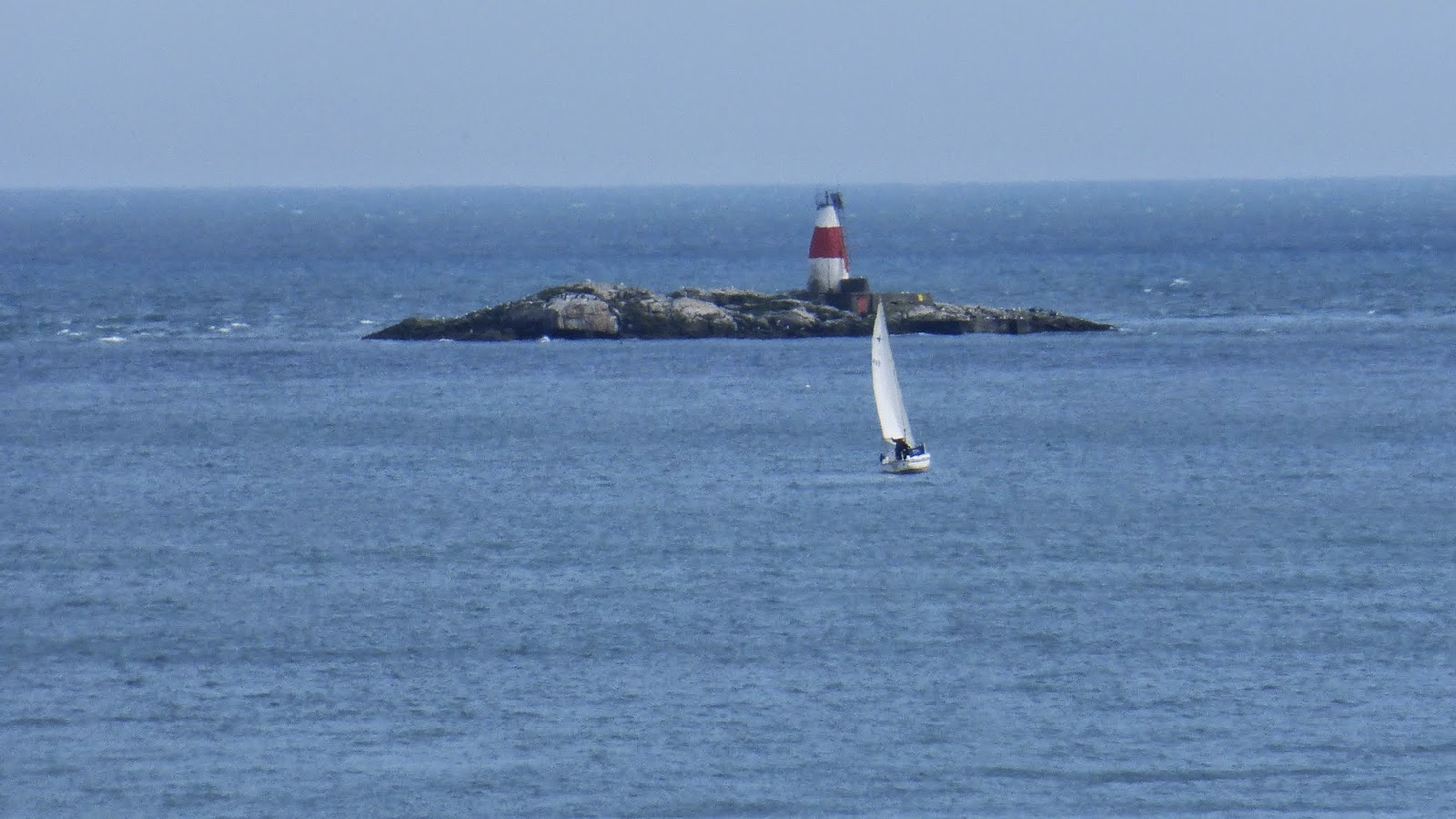
The small island mentioned by Stephen Dedalus
in the beginning of Ulysses


"Stephen's boots crush crackling wrack and razor shells, squeaking pebbles, wood sieved by the sandworm, lost Armada.  Open your eyes, a stride at a time.   Am I walking to eternity along Sandymount Strand?"


A sketch of the tower


The walk from the train station at Dun Laoghaire, down the boardwalk and beach toward Sandy Cove and the tower, was particularly moving to me, because I read Portrait of the Artist as a Young Man, and its rough draft simply titled Stephen Dedalus, as an impressionable teenager in high school.  I remember being heavily influenced by Joyce's creative use of language and stream of consciousness, just like every other writer in the modern/post-modern era.  And too I remember being a typical brooding adolescent and very identified with this protagonist.  This is certainly a privilege, as I never dreamed of being able to walk is if in his shoes.   

From the museum we walk back through the village of Sandymount, filled with lovely stone houses and gardens.  


A magpie 


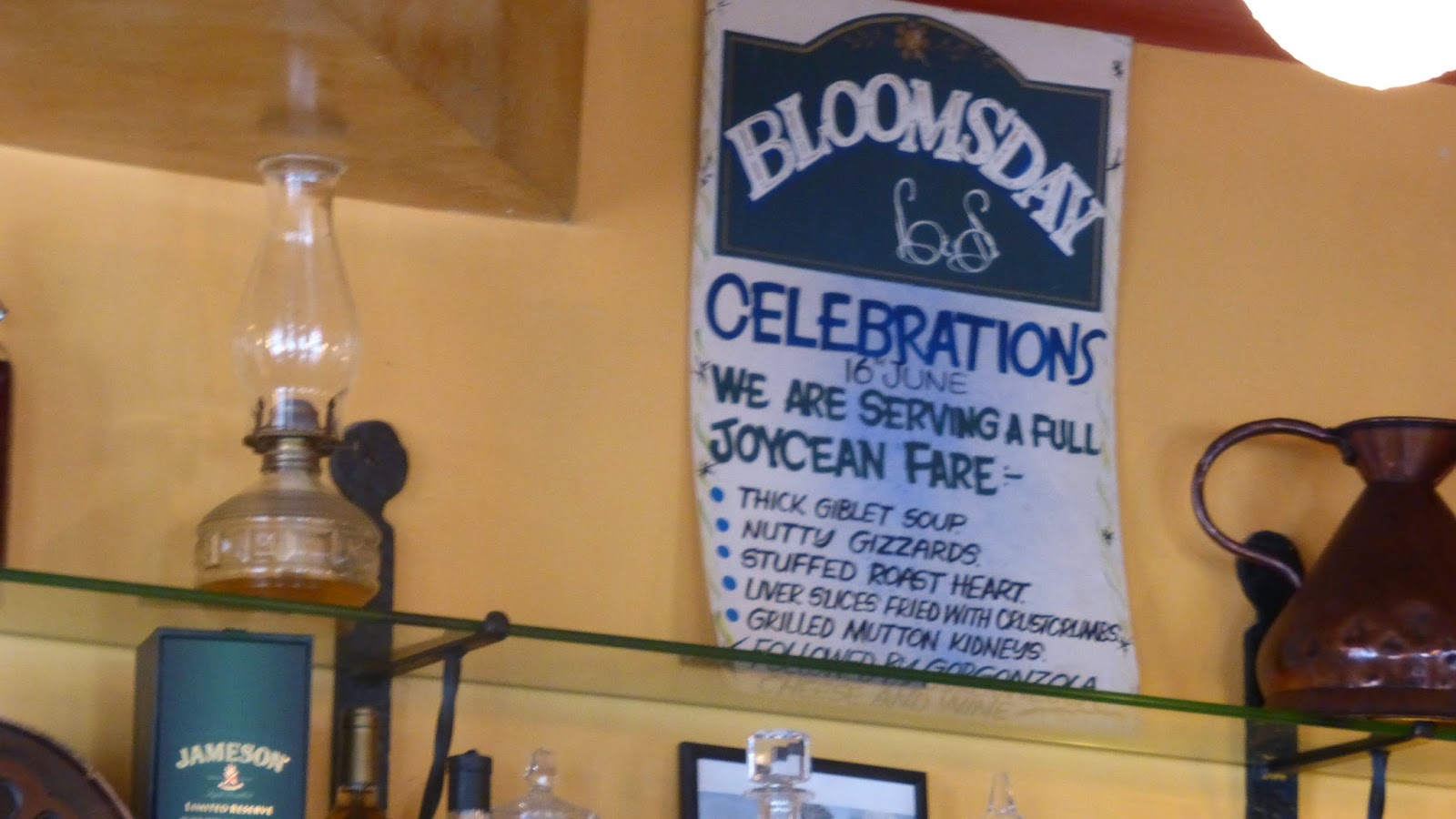
Then we land in a pub which regularly holds a Bloom-fest on June 16 to celebrate the original in 1904.  Its windows have stained glass panels illustrating the sections of the famous book.


Stained glass panels representing the different sections of the book Ulysses. 


Wall painting quoting from Ulysses

An announcement for a Bloomsday Celebration at the Sandymount pub

DART Train home to Connelly Station and the #14 bus to Churchtown.   Steve cooked dinner and we watched Law & Order on TV as we were exhausted from our adventures.  I have begun reading Irish history and legends.  Its a mixture of myth, magic, Christian and pagan lore, Celtic, Gaelic, Norman, Norse, Roman and English influences.   Not simple.  There is a strong pagan mystery behind the arts and literature.  The Filli were oral storytellers - the early bards - during the time of the Druid priests.  The ancient tales were passed along simply through song, ballad and poems long after other cultures on the European continent employed written language.  As a result Ireland to this day retains its strong oral storytelling culture and is famous for its bards.

Tomorrow The Book of Kells at Trinity College and perhaps the National Museum for some archeological history.

Monday Newgrange and the ancient tombs at Bru na Boinne.